Best Portable Bluetooth Speakers Under $100 - 2026 Review
Portable Bluetooth speakers are one of the categories where the brand tax is highest and the value gap is widest. JBL and Sony are genuinely good — and genuinely expensive. The interesting story in 2026 is how close the Chinese audio houses have gotten to them in the sub-$60 bracket.
I have cycled through a JBL Charge 5, a Sony ULT Field 1, a Tribit Stormbox, an EarFun UBOOM, and a Mifa Wildbox over the past two years. This is what actually separated them, and where the money is well spent versus where it is not.
The spec sheet that matters, translated
Marketing pages lead with numbers chosen to look impressive. These are the ones that predict how a speaker will feel in your hand and in your room.
Driver size and total power. A 5W pocket speaker and a 30W party box are different products that happen to share an input jack. Driver diameter sets the physical limit on bass; wattage sets clean headroom. A 2-inch driver cannot move enough air for real low end no matter what the EQ does.
Waterproofing (IP rating). IPX5 survives splashes and rain. IPX7 survives being dropped in a pool. IP67 adds dust sealing, which matters more than people think if the speaker lives in a beach bag. Below IPX6, do not take it near water on purpose.
Battery: rated vs real. A “24-hour” claim is normally measured at 50% volume with the bass boost off. Realistically, expect 55-65% of the claim at the volume you actually use. My Charge 5 delivered about 13 hours at a genuinely loud patio level against a 20-hour claim.
Weight. “Portable” spans a 180 g clip-on and a 1.4 kg brick. Check grams, not the word.
Codec support. AAC and SBC are baseline. LDAC and aptX matter if your source supports them, which on iPhone it generally does not.
The safe flagships, and what the badge buys
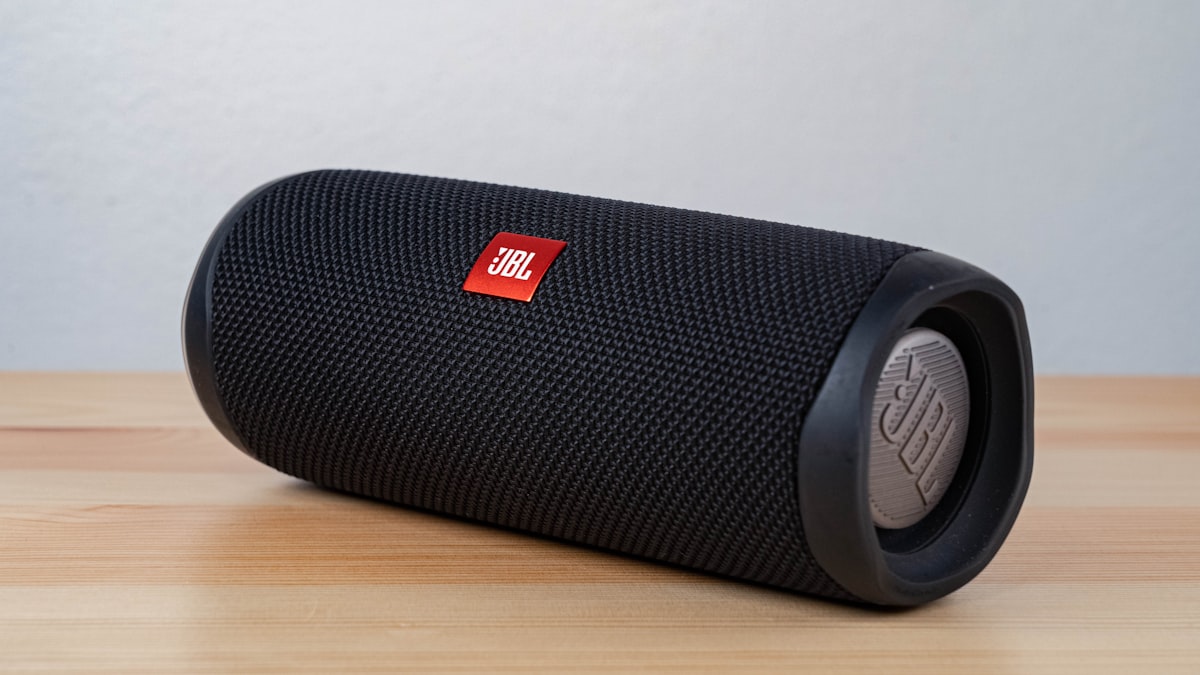
JBL Flip 6 and Charge 5. These are the default recommendation for a reason. The tuning is balanced, the housings are genuinely rugged, the passive radiators give real low-end punch, and the failure rate is low. The app is fine. The PartyBoost pairing works.
Sony ULT Field 1 and the XB series. More bass-forward, more aggressive DSP, and a rugged build. The ULT Field 1 in particular is a strong outdoor choice with a strap that actually survives use.
What you pay for with either brand is consistency and warranty service, not superior acoustic engineering. Neither is worth a 2x premium unless the badge and the replacement policy are worth something to you.
Why Chinese audio brands are the smart money
Tribit, EarFun, Mifa, and Tronsmart are Shenzhen houses that compete almost entirely on sound-per-dollar. They do this by using the same tier of driver supplier as the majors, skipping Western retail markup, and competing on price rather than on brand.
- Tribit: the “surprisingly good for the price” reputation is earned. The Stormbox series delivers bass that embarrasses speakers twice its price. The StormBox Blast is legitimately a small party speaker.
- EarFun: tuning leans clean and balanced rather than bass-heavy. The UBOOM line is a good pick for acoustic music and podcasts, with genuinely surprising low end for the cabinet size.
- Mifa: the rugged, outdoorsy option. Long battery, chunky housings, often IPX7, frequently under $50.
- Tronsmart: aggressive on features per dollar; watch the firmware updates.
These are not knockoffs. They are competent engineering with a shorter brand history and no distribution deal to amortize. For most backyards, picnics, kitchens, and desk corners, they are all the speaker anyone needs.
Where Chinese brands have caught up, and where they have not
Caught up: driver quality, basic tuning, waterproofing, battery management, USB-C charging, Bluetooth 5.3 range and stability.
Still behind: app quality and firmware polish, the deep DSP tuning that makes a Charge 5 sound coherent at high volume, long-term warranty service in the West, and multi-speaker pairing ecosystems. If you want to chain four speakers across a yard, JBL’s ecosystem still wins.
Honest caveats
- Max-volume distortion. Cheap speakers get tinny when pushed. Buy one size up rather than cranking a small one.
- Bluetooth version. 5.3 and up pair faster, hold a more stable connection, and reach farther. Prefer it, but do not pay a premium for it alone.
- “Deep bass” on a small driver is marketing. Physics decides bass. Size and passive radiators decide bass.
- Weight claims are optimistic. A speaker listed at 400 g often ships at 480 g.
- Battery claims are measured quietly. Halve the headline if you listen loud.
Matching the speaker to the use case
- Shower or poolside: IPX7 minimum, small, cheap enough that a loss is not a tragedy.
- Backyard BBQ: 20W+, a passive radiator, 15+ real hours.
- Hiking and camping: light, rugged, IP67, with a strap or clip.
- Desk and kitchen: sound quality over volume; a balanced 10W unit beats a boomy 30W one in a small room.
- Party: either a big single unit or two speakers with stereo pairing.
Most people buy for the loudest case they can imagine and then use the speaker at a desk. Be honest about which case you are actually in.
The Chinese brand angle worth naming
If you want to stay inside a brand family you already trust for other gear, the Chinese names worth knowing are not limited to audio:
- Xiaomi — its speaker line is competent and priced aggressively, and it pairs cleanly with the Mi ecosystem.
- Baseus — strong on the charging and accessory side of the same trip.
- Ugreen — the safe default for cables and power banks that travel with the speaker.
Major tech brands like Xiaomi, Baseus, and UGREEN provide dependable, high-value choices across portable electronics and everyday travel gear.
My take
If you want the badge and the rugged guarantee, JBL earns it, and the Charge 5 remains the safest single answer under $100. But for about 90% of real use — a patio, a picnic, a kitchen, a beach day — a Tribit or EarFun delivers the same afternoon of music for half the money. Spend the difference on the picnic.
The one mistake to avoid is buying the cheapest 30W-looking listing from a no-name seller. That is the one place in this category where you genuinely get what you pay for, and it is rarely good.
Where to look
The one I would start with, after cycling through five speakers:
Disclosure: if you order through our link, TechMinds may earn a small commission at no extra cost to you.